
Code-named Pelican, bigger hatchback with new petrol and diesel engines may hit the road next year.

Passenger vehicle wholesales in India rose by 14.16 per cent in August to 2,15,916 units, driven by pent-up demand, industry body SIAM said on Friday. According to the latest data by the Society of Indian Automobile Manufacturers, passenger vehicle wholesales stood at 1,89,129 units in the same month last year.

The electric vehicle evolution in India's passenger vehicle market has remained frozen in time and may see limited adoption over the next decade, experts say.

The economy segment of India's car market is unlikely to revive soon term as inflation and prices prompt buyers to defer purchases. The share of entry-level cars in the passenger vehicle market dropped to the lowest in seven years at the end of the Financial Year 2021-22 (FY22). A recovery in the segment will be largely driven by the overall economic growth, improvement in income levels, and easing of semiconductor shortage, say carmakers and analysts.

One can see the scale of recalls going up as the market expands.

First-time buyers of cars and sport utility vehicles (SUVs) have made a comeback, shows last year's data from top passenger vehicle (PV) makers. If the trend persists, it may move the needle on the overall car penetration ratio. India's car penetration ratio is 32 per 1,000 people - one of the lowest, compared to mature car markets like the US and Europe.

As per SIAM data, vehicle sales across categories, including passenger vehicles and two-wheelers and commercial vehicles stood at 18,21,490 units last month as against 23,82,436 units in August 2018, a fall of 23.55 per cent.

Dealers across brands are slashing prices by Rs 20,000 to over Rs 1 lakh, depending on the car model.

What worked for Hyundai in India when so many other auto manufacturers have had to eat humble pie? Pavan Lall finds out.

'Some buyers get carried away by festival offers and purchase higher variants or larger vehicles than they truly need, which impacts running cost and long-term affordability.'

Despite a rise in input costs, leading car-makers refrain from hiking their price.

Tata Zica was designed by an international team resulting in a more modern look.

Let alone a discount, they might not even get the model, variant or colour of choice in BS-IV-compliant vehicles.

Auto sector cheers RBI rate cut as 'festival gift'
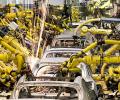
Indian automobile units are employing more and more robots to improve your car's efficiency. India is catching up well as world over, the latest technologies is redefining outdated manufacturing processes.

The company had launched the Yaris in May 2018 at a price range of Rs 8.75 lakh and Rs 14.07 lakh (ex-showroom), competing with the likes of Honda City, Hyundai Verna and Maruti Suzuki Ciaz. However, it didn't have a robust response in the market, clocking a cumulative wholesales of around 19,800 units.

Amid slowing volume sales among India's major automakers, Toyota Kirloskar Motor (TKM) has defied the trend with strong growth, driven by demand for hybrid vehicles and a reliable product line up. The company expects this momentum to continue in 2025. "The overall response to our cars has been fabulous. So, we foresee the same momentum in 2025 as well," Sabari Manohar, vice-president, sales-service-used car business, TKM, said.

Market leader Maruti Suzuki is putting finishing touches to its plan of finding its feet in what is being hailed as a battle of epic proportions in India's fastest-growing passenger vehicle segment, reports Arindam Majumder.

Sales of diesel-powered utility vehicles have been declining in the past six months as the differential between petrol and diesel prices narrowed.

While the share of diesel vehicles sales in the overall passenger car industry has already fallen sharply, sales of CNG vehicles have shown a compound annual growth rate of 15.5 per cent over the past five years.

While offering discounts of up to Rs 1 lakh, Hyundai, Ford and Honda are also hiking prices by 1-2% from January, Swaraj Baggonkar/Business Standard reports from Mumbai.

After the easing of lockdown in mid-May, auto companies were able to resume production in a phased manner, but the ramp-up was slow due to a broken supply chain, and lockdown-induced restrictions.

Maruti Suzuki, Hyundai, Mahindra and Toyota reported low single-digit sales growth for the month owing to weak market sentiment

General Motors India Vice President P Balendran termed the decision as a positive move for the overall economy.

According to industry data, for two months, sale of the Zest (7,359 units) were higher than that of Amaze (6,792 units).

Vehicle prices have gone up as manufacturers gear up for the transition to stricter emission norm BS-VI from BS-IV beginning April 1.

With the new Verna, Hyundai takes on Honda. Beating the Honda City is something the country's second-largest car maker has taken upon itself with its new launch. Will it succeed?

This is the seventh straight month of growth

Car makers are trying hard to boost sales in India.

Big brands like Hyundai, Mahindra and Mahindra (M&M), Toyota and Renault have lost share.

Ford is among several multinational automobile companies in India for whom exports now bring bigger volumes than local sales.

Japanese automaker Honda Motors is rolling out its small car in India by the last quarter of calendar 2009.

Passenger vehicle wholesales in India declined by 10 per cent to 2,61,633 units last month as compared to March this year, as COVID-19-led restrictions across various states impacted demand, auto industry body SIAM said on Wednesday. Passenger vehicle sales in March 2021, stood at 290,939 units.

New Hyundai Verna 2017 is powered with a choice of 1.6 L petrol engine (Dual VTVT, 121.3 bhp) and 1.6 L diesel engine (U2 CRDi VGT, 126.2 bhp).

Japanese car major Nissan on Tuesday said will hike the prices of its vehicles, including hatchback Micra and sports utility vehicle Terrano in India, by up to 4 per cent from next month in order to offset the impact of rupee depreciation and escalating input costs.

Even as India's passenger-vehicle sales touched a record high of 3.9 million units in 2022-23, growing 27 per cent over the previous financial year, the country's largest carmaker, Maruti Suzuki India (MSIL), said on Monday uncertainties in the electronic-component supplies might affect production in FY24. MSIL said the shortage of electronic components had some impact on production in FY23. "The company took all possible measures to minimise the impact.

Car sales are likely to grow further in November.

Companies also said confidence was yet to return among buyers, with many holding back their decision to buy cars.

The company sells a range of vehicles from three-wheelers to high-end sports utility vehicles.

The GST Council last year imposed a cess of 15 per cent on hybrid vehicles, in addition to the 28 per cent GST, leading to a total tax burden of 43 per cent against a previous tax rate of 28 per cent.
